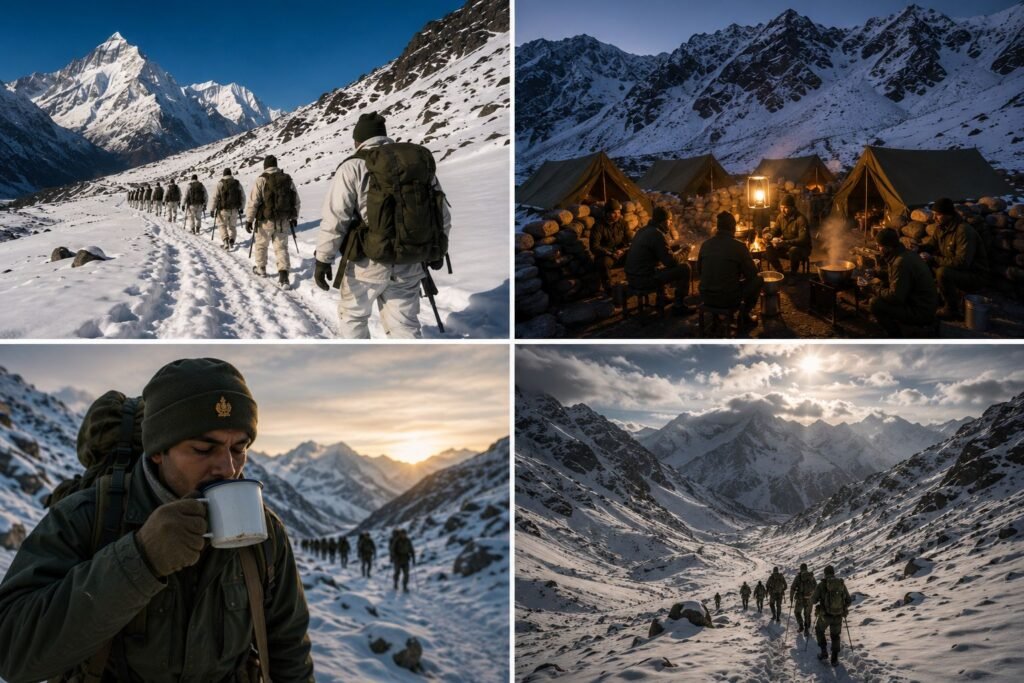
A true story of soldier innovation, experience, and leadership from the icy heights of the Himalayas.
By Maj Yogendra Yadav, IAS (Retd.)
“There is no substitute for experience.” Every young officer hears those words. Most of us understand them only years later. I learnt that lesson during my very first posting as a Second Lieutenant in a high-altitude area of the Himalayas, where I witnessed an unforgettable example of soldier innovation.
Fresh out of the Officers’ Training School (now the Officers’ Training Academy), I wore my stars with immense pride. Like many young officers, I also carried something invisible—a quiet confidence that I knew what I was doing.
It did not take the mountains long to correct me.
Within days of reporting to my unit 19 Mechanised Infantry, I was ordered to lead a Long Range Patrol (LRP) through snow-bound mountains in the middle of December.
The previous week had witnessed heavy snowfall, but for several days the weather had remained clear. On the morning of our departure, the sky was a flawless sheet of Himalayan blue.
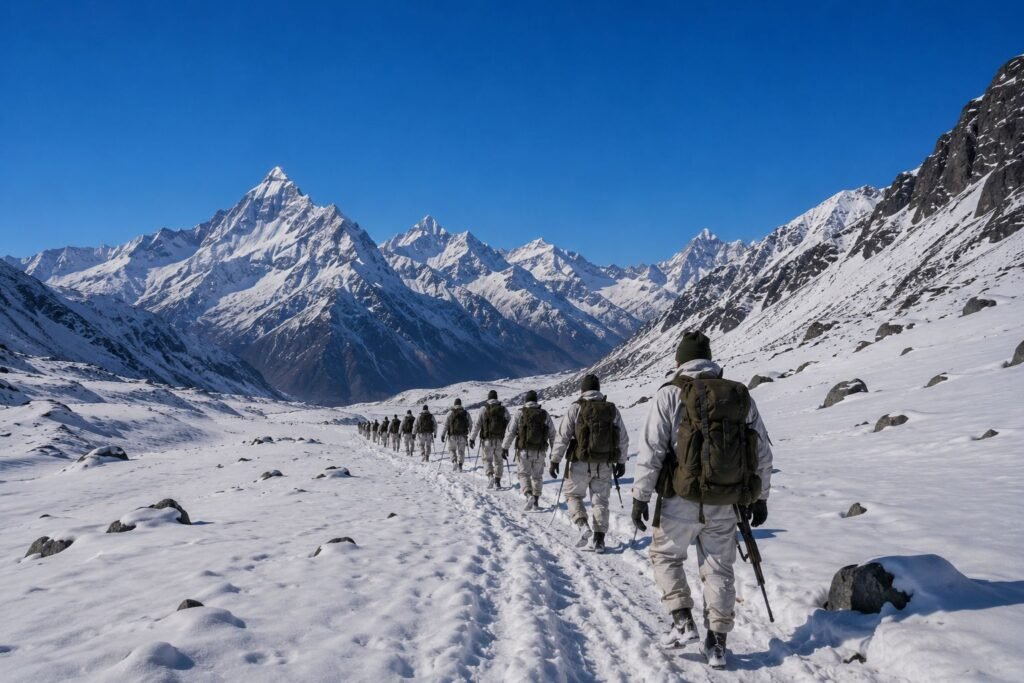
As preparations were underway, my experienced Junior Commissioned Officer quietly looked towards the mountains before saying,
“Saab… by evening the weather will turn. We are likely to get heavy snowfall.”
I looked up. Not a cloud in sight.
Smiling with the confidence only youth can possess, I replied,
“Arre Saab… aasman bilkul saaf hai. Baraf nahin girne waali.”
The JCO did not argue. He simply smiled, saluted and replied,
“Phir bhi Saab… taiyyari karke jaane mein koi nuksaan nahin hai.”
“Even then, Sir… there is no harm in being prepared.”
Looking back, I realise that sentence carried decades of mountain wisdom.
His words reminded me of something an instructor had once told us during our Academy days:
Always carry an umbrella. If it rains, you stay dry. If the sun shines, it gives you shade. If neither happens, the umbrella becomes a stick to chase away stray dogs.
Preparation never goes to waste.
So I filled my haversack with spare woollens, socks, gloves, a warm cap and a rain cape. It proved to be the best decision I made that day.
After lunch, our patrol moved out with a resounding battle cry that echoed through the valley.
For nearly five hours we climbed through rugged mountain tracks until we reached the base of the next mountain pass.
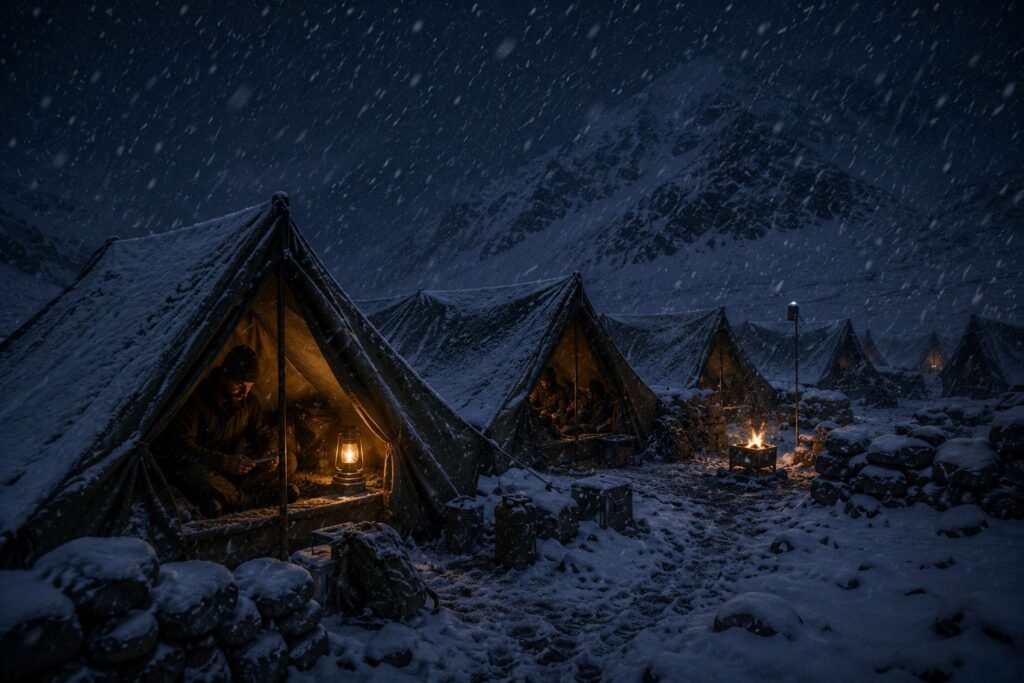
By dusk, our little camp had come alive. Tiny two-man tents appeared as if by magic. The field kitchen was already at work. The aroma of hot tea drifted through the icy air. Dinner consisted of parathas and tinned mutton. After carrying heavy loads through unforgiving terrain, it tasted like a feast fit for kings.
At three in the morning, my sahayak gently woke me.
“Tea, Saab.”
Still half asleep, I opened the zip of my tent.
A wall of fresh snow crashed onto my face.
The world outside had vanished.
Everything was white.
The tents were half buried.
The JCO had been absolutely right.
By four o’clock we were climbing again.
The scouts led the patrol. The snow was knee-deep. Every step demanded effort. The biting cold made breathing painful. Conversation disappeared. Only the rhythmic crunch of boots broke the silence.
For over two hours we climbed without stopping.
Then, just as dawn painted the mountains in shades of orange and gold…
Someone tapped my shoulder.
My sahayak stood smiling.
In his hand… was a steaming mug of tea.
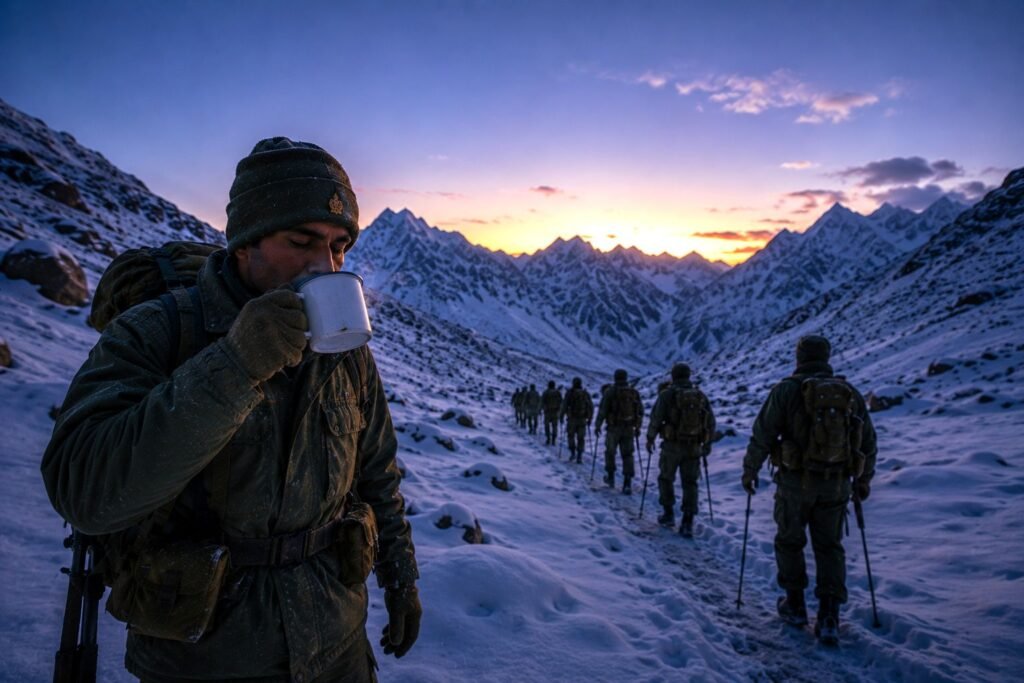
As I returned the mug, he handed me a steel plate.
On it sat a perfectly cooked hot paratha with pickle.
That was enough.
“HALT!”
The patrol stopped instantly.
Trying to hide my bewilderment, I asked the JCO,
“Saab… we have been marching continuously through knee-deep snow for over two hours. Nobody has stopped. So where exactly is this hot tea and fresh paratha coming from?”
The JCO smiled and called out,
“Baljeet! Sukhwinder! Saab ke saamne haazir ho!”
Soldier Innovation at Its Best
Within moments two young Sikh soldiers stood before me.
Neither carried a rifle.
Instead, Baljeet had a kerosene stove mounted on a wooden platform suspended from his neck with an iron tava on top. Behind him walked Sukhwinder carrying bowls of dough and flour. Two other soldiers quietly carried their rifles.
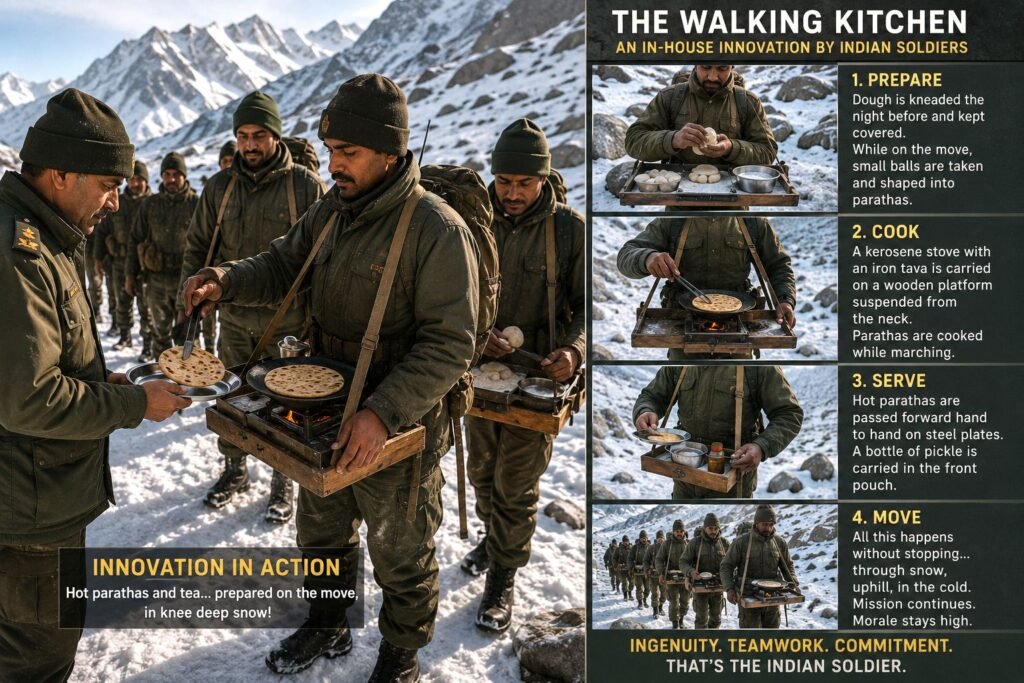
The JCO explained that the dough had been prepared the previous evening. As the patrol marched, Sukhwinder rolled each paratha while Baljeet cooked it on the burning stove. Another soldier carried plates and yet another carried pickle. Freshly cooked parathas travelled from one hand to another until they reached the patrol commander—still hot, still soft.
I ordered the three innovators to walk directly in front of me.
What I witnessed over the next thirty minutes remains one of the finest examples of soldier innovation and ingenuity I have ever seen!
Without stopping.
Without breaking stride.
Without missing a beat.
Dough became a perfect circle.
The tava hissed.
The paratha puffed.
Pickle appeared.
Breakfast arrived.
All while climbing through knee-deep Himalayan snow.
It was engineering.
It was teamwork.
It was fieldcraft.
It was pure Indian Army.
We finally halted near a rock shelter, where every man enjoyed hot parathas and steaming tea prepared by Baljeet, Sukhwinder and Gurtej—the guardian of the pickle bottle.
More than thirty years have passed.
Whenever someone asks me – especially my civil servant freinds – what makes the Indian Army extraordinary, I don’t think first of tanks, guns or helicopters.
I think of three soldiers climbing through knee-deep Himalayan snow… quietly making hot parathas.
That morning, I learnt something far more valuable than mountain warfare.
Leadership isn’t about knowing everything.
It is about recognising, trusting and celebrating the wisdom of the people you lead.
That lesson has stayed with me throughout my career.
And I suspect… it always will.
About the Author
Major Yogendra Yadav, IAS (Retd) was commissioned into 19 Mechanised Infantry Battalion in August 1985 (SS NT Course 40). After distinguished service in the Army, he served as a Civil Servant in the states of Uttar Pradesh and Uttarakhand, holding important positions. He retired as Additional Secretary, Government of Uttarakhand, and is now settled in the NCR, Delhi.
Enjoyed this story?
Life in Uniform brings you true stories from veterans of the Indian Armed Forces—stories of courage, camaraderie, humour, leadership and the everyday moments that never make it into official histories. Please share it among your friends on Social Media.
Explore more articles in the Life in Uniform series and follow Fauji Tales on WhatsApp, Facebook and Instagram.
Fauji Tales – Where Military Memories Live On.
Note
The images in this article are AI-generated and used for illustrative purposes. They are symbolic and do not depict real events or individuals.
Share your Story
Have a story from life in uniform that deserves to be told? Here is a platform for you!
Fauji Tales is built on real experiences—moments of humour, courage, and camaraderie that often remain within the fraternity.
If you have a story to share, we would be honoured to feature it.
Please visit the Share a Story section on the website to view simple guidelines and submit your story.
This is the charm of a military set up,even for the the other organisations though they are confirred degrees of management there is nothing like well and meticulous form.Consistency of mannerisms is there always.
Hi Tehmpton, Thanks for your lovely comments.
Best regards,
Poorna