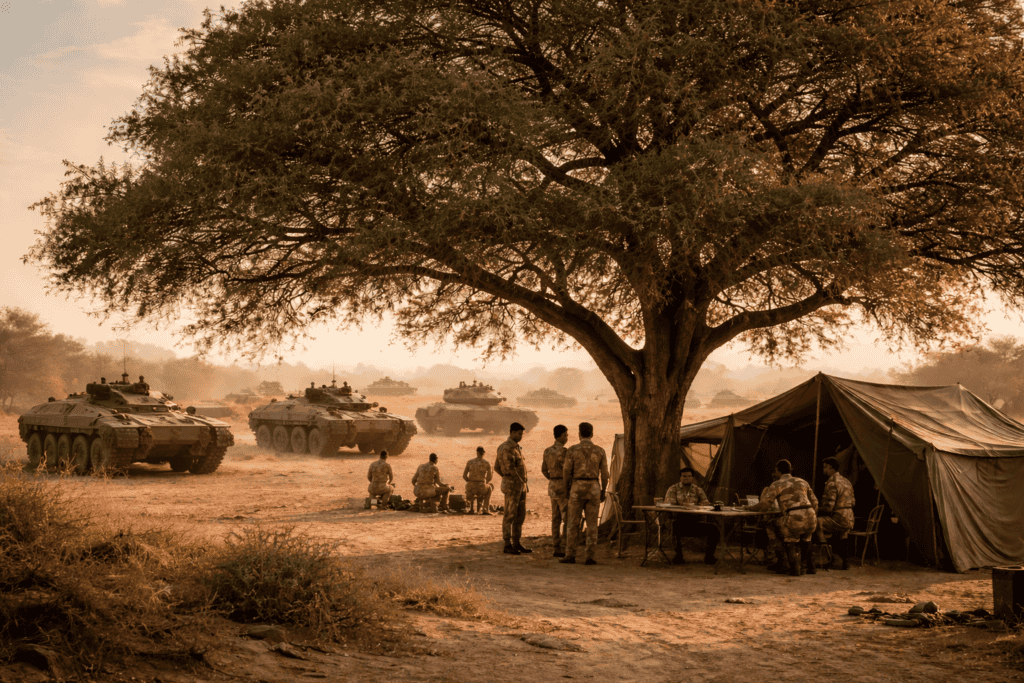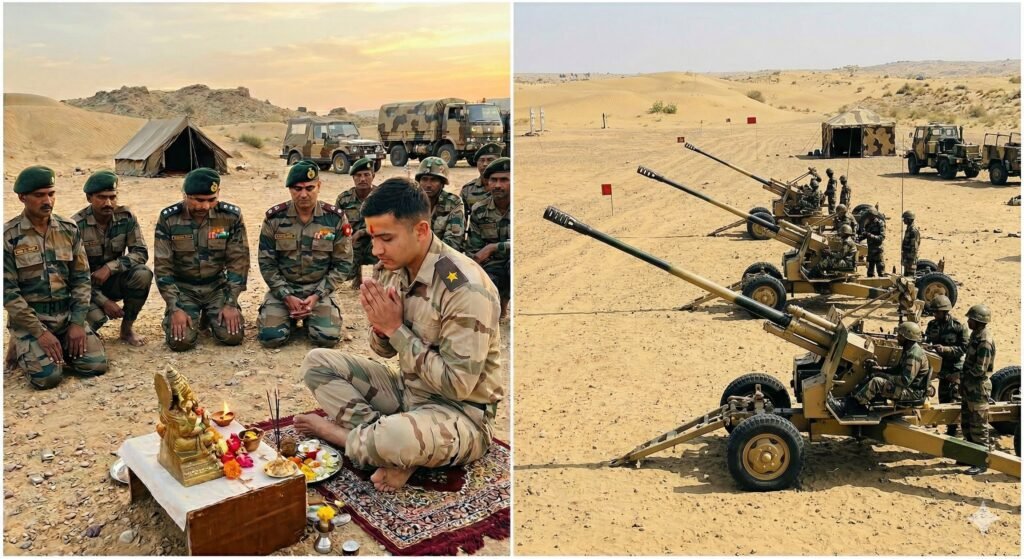
Our unit was deployed at the Pokhran ranges for Air Defence firing practice. Anyone who has been to Pokhran knows that the desert there has a personality of its own—sand everywhere, a relentless sun, and the occasional desert breeze that carries half the Thar with it.
Though it was technically my first year of service as an officer, I had already spent more than eleven years of my Life in uniform—RIMC, NDA and IMA included. By then, khaki and olive green felt more natural than civilian clothes ever could!
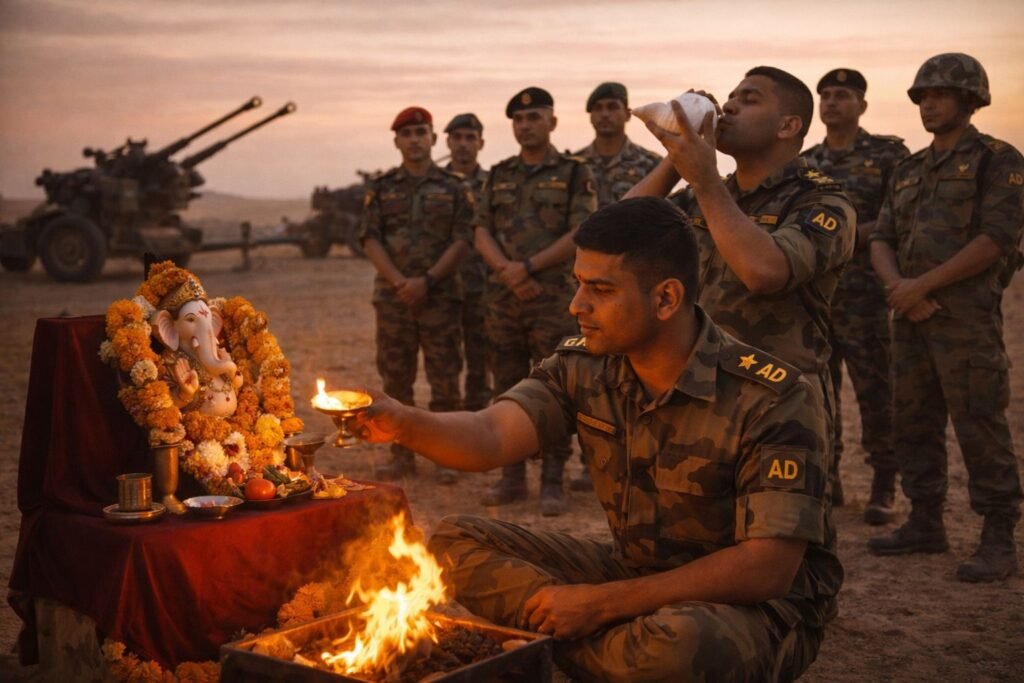
Like many units in the Indian Army, we had a simple but deeply respected custom: before the day’s firing began, we conducted a small pooja for safety and success.
Day One went perfectly. The guns fired beautifully, targets dropped, and everyone returned to the field mess in good spirits.
But that evening, during dinner, the adjutant walked up to the CO with a slightly worried look.
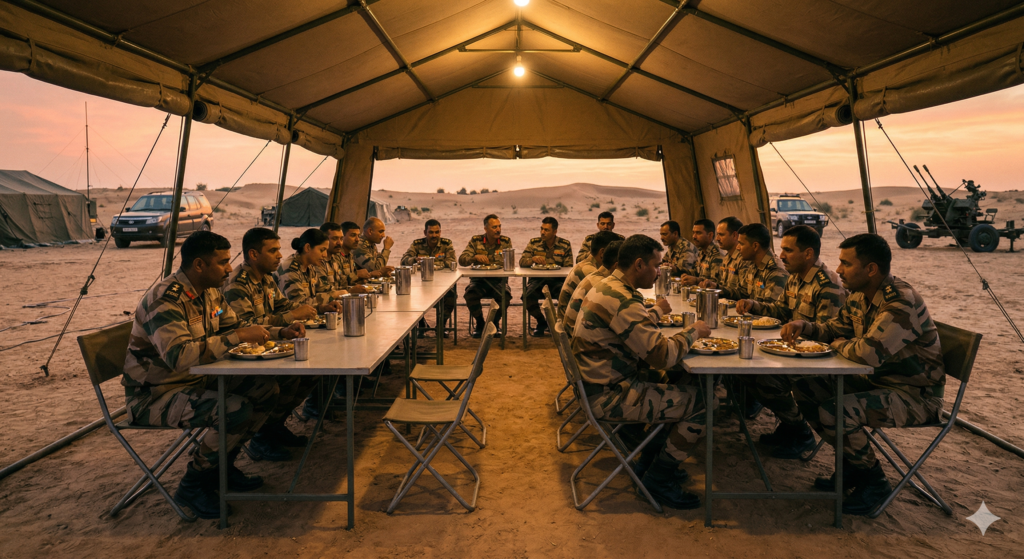
“Sir… Panditji has had to rush home due to an emergency.”
The CO paused mid-bite.
“No Panditji tomorrow?”
“No, Sir.”
Now, firing could not begin without the customary pooja. That much was non-negotiable.
The adjutant started suggesting a few jawans who happened to be Pandits by caste. The CO, who himself was a thoroughbred Brahmin, didn’t look convinced.
He slowly scanned the mess… his eyes finally resting on me.
At that moment, I was happily chewing on a chicken bone and washing it down with rum.
“Jacob,” he said calmly.
I froze.
“You will officiate as Panditji tomorrow.”
I nearly choked on the chicken.
“Sir… me?”
“Yes. You are the youngest officer here. And a bloody Rimcollian.”
He waved his hand decisively.
“You fit the bill of a Panditji.”
Now, when the Commanding Officer —also known affectionately and fearfully as the Old Man—makes such an announcement, discussion is generally discouraged.
I looked around for moral support.
The entire mess was watching the spectacle with poorly hidden smiles.
I quickly finished my rum and replied, with what I hoped sounded like confidence,
“Yes, Sir. I will be… a Pandit.”
That night, salvation arrived in the form of my senior subaltern, Lt Abir Bannerjee. A proper “Janeu” wearing Brahmin from Bengal, Abir knew his mantras.
He walked into my tent carrying three things essential for serious military learning:
- A bottle of rum
- A packet of cigarettes
- And his guitar
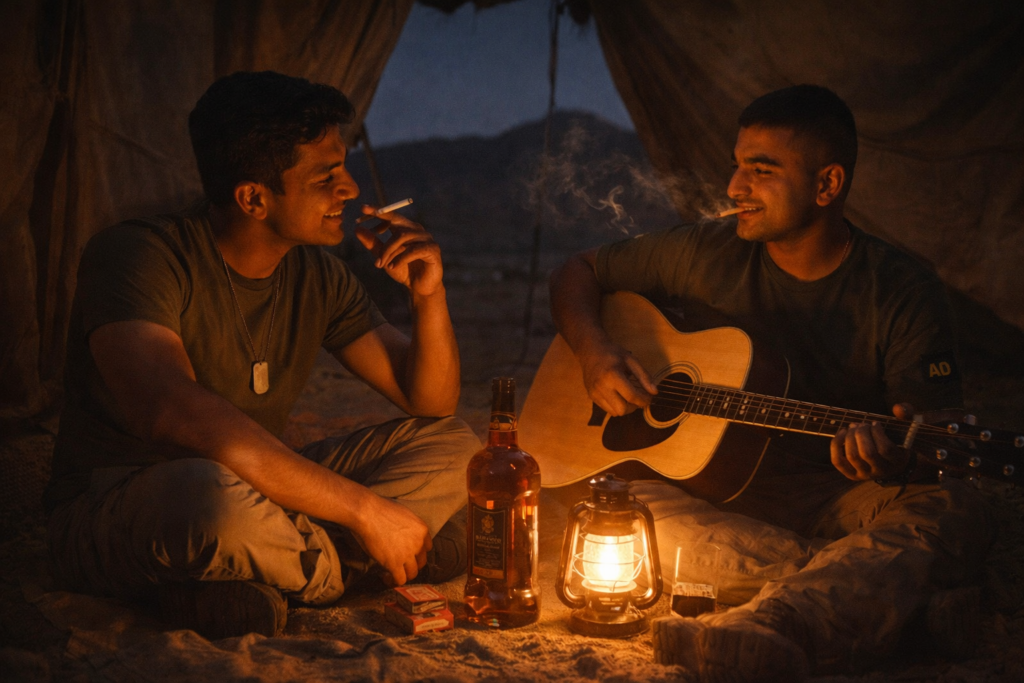
“Right, Jacob,” he said, lighting a cigarette. “Let us make a Pandit out of you.”
For the next few hours, between sips of rum and occasional guitar strumming, he coached me through the mantras. To my surprise, many of them sounded familiar. They were the same shlokas we had been chanting half-heartedly during mandir parades in RMC for years.
By early morning, I was reasonably confident that I could at least sound like a Pandit—even if I wasn’t entirely sure what I was saying.
At dawn, the Subedar Major arrived with Naik Shukla, who was clearly the real expert in these matters.
Shukla gave me the finishing touches.
Then came the most difficult part.
Blowing the conch.
He demonstrated once.
Then handed it to me.
I tried.
Nothing happened.
I tried again.
Still nothing.
The Subedar Major watched this tragic performance for a while and finally declared with great wisdom,
“Saab, conch Shukla hi bajayega.”
That decision probably saved the dignity of the entire ceremony.
The pooja began shortly afterwards. I recited the mantras with the confidence of a man who had practised all night under the influence of rum and Bengali scholarship.
The ceremony concluded successfully. Shukla blew the conch magnificently, the coconut broke perfectly, and the guns rolled out.
What followed was some of the best firing our unit had ever done. Targets fell one after another until finally, the Air Force Dakota towing the targets ran out of them.
That evening, at the mess, the Commanding Officer raised his glass and made an official announcement.
“From tomorrow onwards,” he said, smiling slightly, “Jacob will continue as the Unit Panditji for the rest of the firing.”
And that is how I spent the next few days conducting pooja before Air Defence firing in the middle of the Rajasthan desert.
That, in many ways, sums up the Indian Army.
In the deserts of Pokhran, as a young officer, I learnt that in the Army, labels fade away rather quickly. A Christian officer can become a Pandit for the day. A Sikh can lead a Christmas service. A Muslim soldier can distribute Prasad.
Because somewhere along the way, we all end up adopting the religion of the troops we serve with.
Only after retirement do many of us rediscover our individual religions again.
Until then, in uniform, there is really just one faith.
The Regiment.
“Uniform first, religion later — that is the unwritten doctrine of the Indian Army.”
Acknowledgement – Fauji Tales is grateful to Brigadier Jacob, who had penned this story. Fauji Tales accessed it through the regimental WhatsApp group, where it was shared.
Note: The images in this article are AI-generated and used for illustrative purposes. They are symbolic and do not depict real events or individuals.
Have a Story to Share?
Do you want to share any interesting incident or anecdote about life in the Indian Armed Forces?
Thank you for reading this story on Fauji Tales.
If it moved you, inspired you, or reminded you of someone who has worn the uniform with pride, please share it with others.