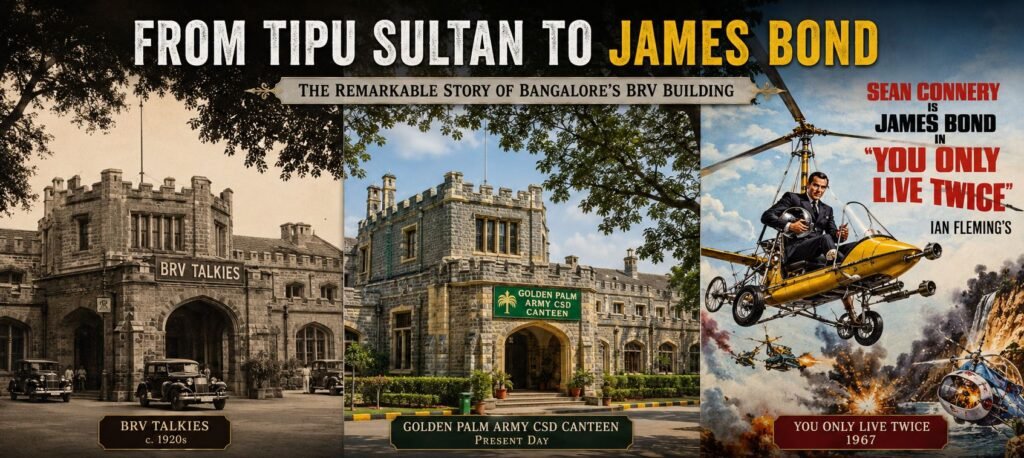
What does a bloody siege against Tipu Sultan in 1791 have in common with a 1960s James Bond blockbuster? The answer stands quietly at a busy traffic junction on Cubbon Road – BRV!
If you have ever waited at the signal near the old Golden Palm Army CSD Canteen on Cubbon Road in Bangalore, you have probably noticed the imposing grey granite building with its fortress-like appearance. Few realise that this structure has lived several lives—military headquarters, armoury, ballroom, cinema hall, and finally a lifeline for generations of soldiers and veterans.
For me, the building has always carried a sense of mystery. Growing up in Bangalore, I often wondered what those three letters—BRV—stood for. Like many Bangaloreans of my generation, I also watched a few Hollywood movies there with my father when it was still BRV Talkies. At the time, it was simply another cinema hall. Only years later did I discover that behind those granite walls lay a story stretching from Tipu Sultan and the Bangalore Cantonment to citizen soldiers, military balls, and even James Bond.
This is the remarkable story of the Bangalore Rifle Volunteers (BRV) Building—a structure that has reinvented itself time and again while remaining a silent witness to more than two centuries of Bangalore’s history.
The Secret Origin: A City Shaped by War
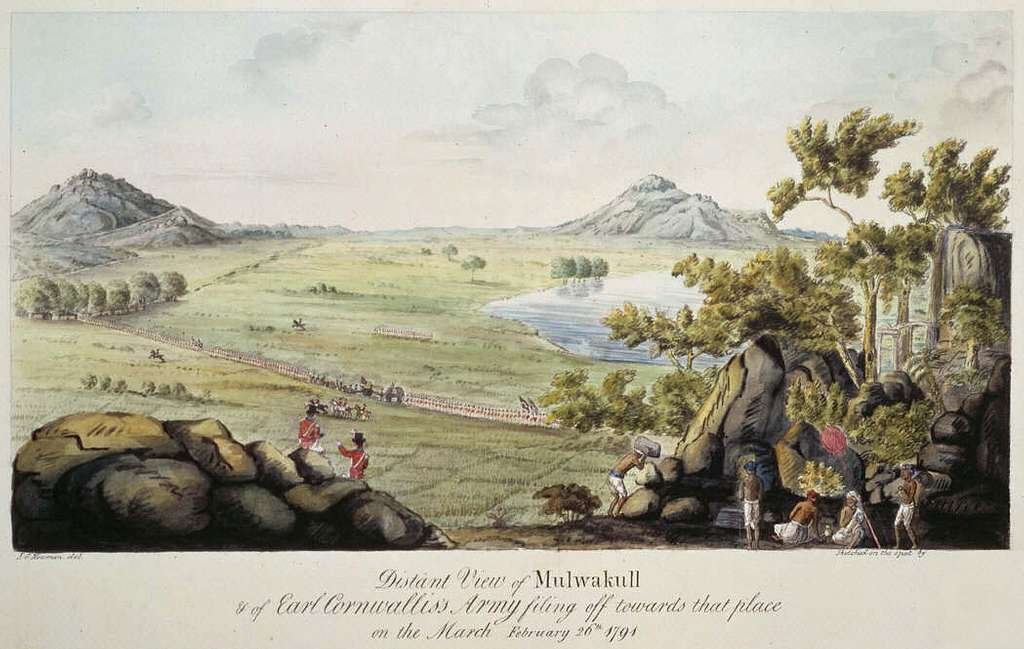
To understand why the BRV Building exists, we must travel back to the night of 21 March 1791, during the Third Anglo-Mysore War.
Lord Cornwallis led British forces in a daring assault on Bangalore Fort, one of Tipu Sultan’s key strongholds. In a fierce midnight attack, the Madras Pioneers breached the fortifications and helped secure the city.
When Tipu Sultan was finally defeated in 1799, the British began searching for a healthier and more strategically located military station than Srirangapatna. Bangalore’s elevated climate and strategic location made it an obvious choice.
In 1809, the Bangalore Cantonment was formally established.
The very roads surrounding the BRV Building today owe their existence to the military and political decisions taken in the aftermath of the Anglo-Mysore Wars.
The Citizen Soldiers of Bangalore
By the mid-nineteenth century, Bangalore had become one of the most important military centres in southern India.
To supplement regular troops, the British raised an auxiliary regiment known as the Bangalore Rifle Volunteers (BRV) on 30 November 1868.
These were not professional soldiers.
They were clerks, railway employees, merchants, businessmen, and other civilians who trained in their spare time and could be mobilised during emergencies.
The BRV reflected a distinctly Victorian military idea: that every loyal citizen should be capable of becoming a soldier when duty called.
Their motto captured this spirit perfectly:
“Defence, Not Defiance.”
A Postcard from Another Era
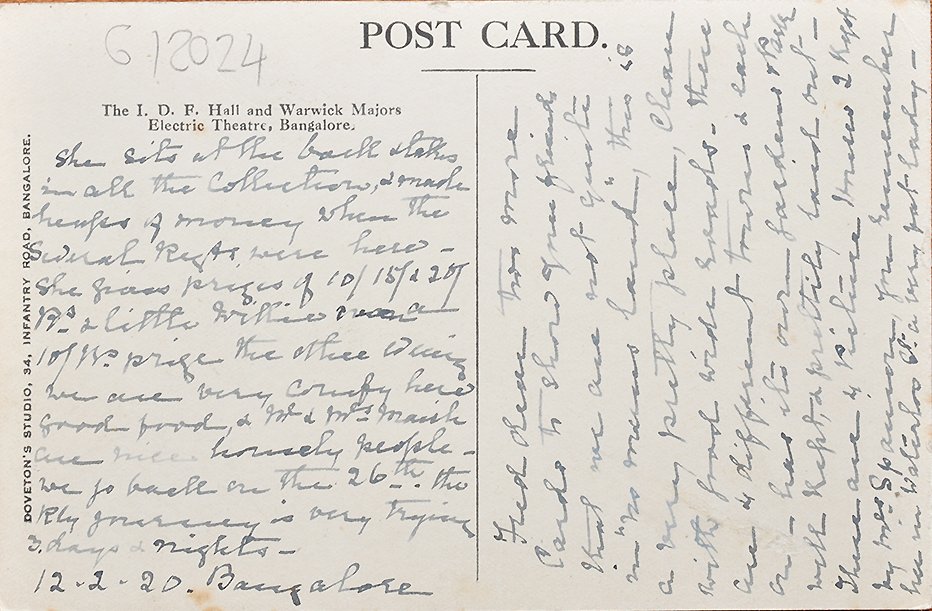
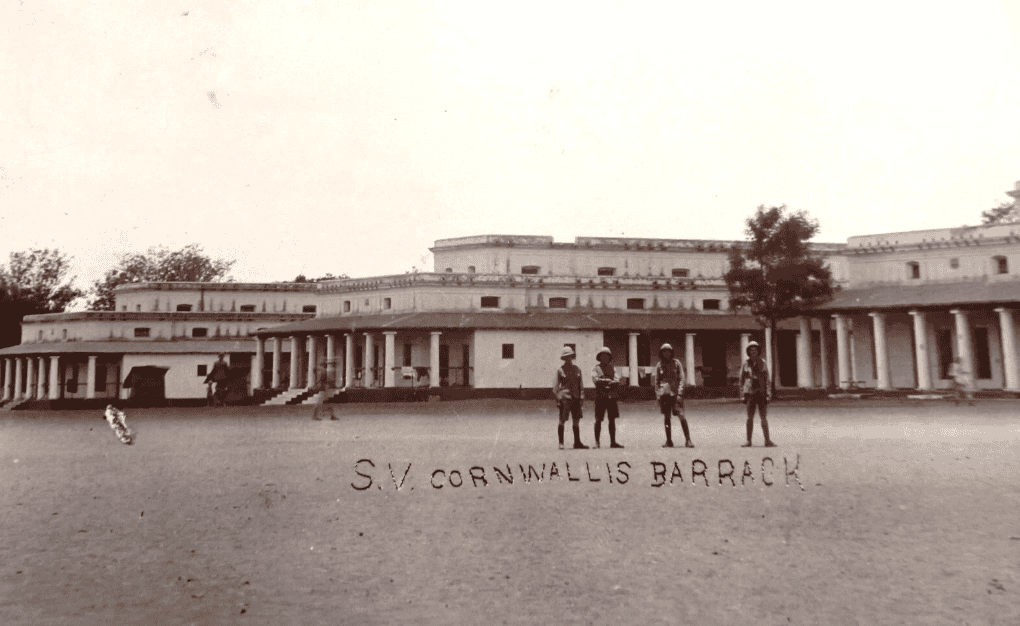
One of the most intriguing pieces of evidence connected to the BRV Building is a rare early twentieth-century postcard showing the structure as the “I.D.F. Hall and Warwick Majors Electric Theatre, Bangalore.”
The postcard appears to date from around 1920 and captures a little-known chapter in the building’s history. While the site originated as the home of the Bangalore Rifle Volunteers (BRV), it briefly acquired an Indian Defence Force (IDF) identity during the First World War period before eventually reverting to the BRV name that Bangaloreans would remember for decades.
The faded handwriting on the reverse side may be difficult to decipher today, but the printed title tells its own story: this remarkable building was already evolving and reinventing itself long before it became the beloved BRV Talkies.
Sometimes, a century-old postcard can reveal an entire forgotten chapter of history.
A Fortress in Granite
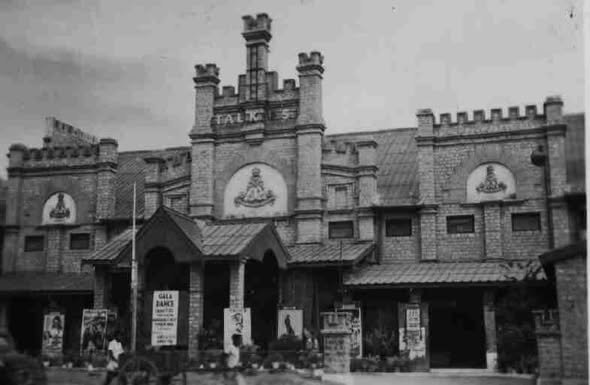
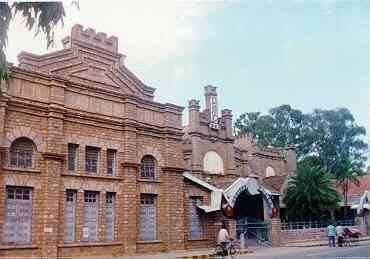
The first BRV building occupied this site during the late nineteenth century. When it became inadequate, it was demolished in 1905.
The present structure arose in 1912, built by the Madras Pioneers, by then renamed the Madras Sappers.
History had come full circle.
The same military engineering tradition that had helped capture Bangalore more than a century earlier had returned to construct one of the city’s most enduring military landmarks.
Built in an impressive Tudor Revival style, the structure featured ashlar grey granite walls, gabled porches, crenellated battlements, and castle-like architectural details reminiscent of Bangalore Palace.
The result was less an office building and more a military manor house.
More Than a Military Headquarters
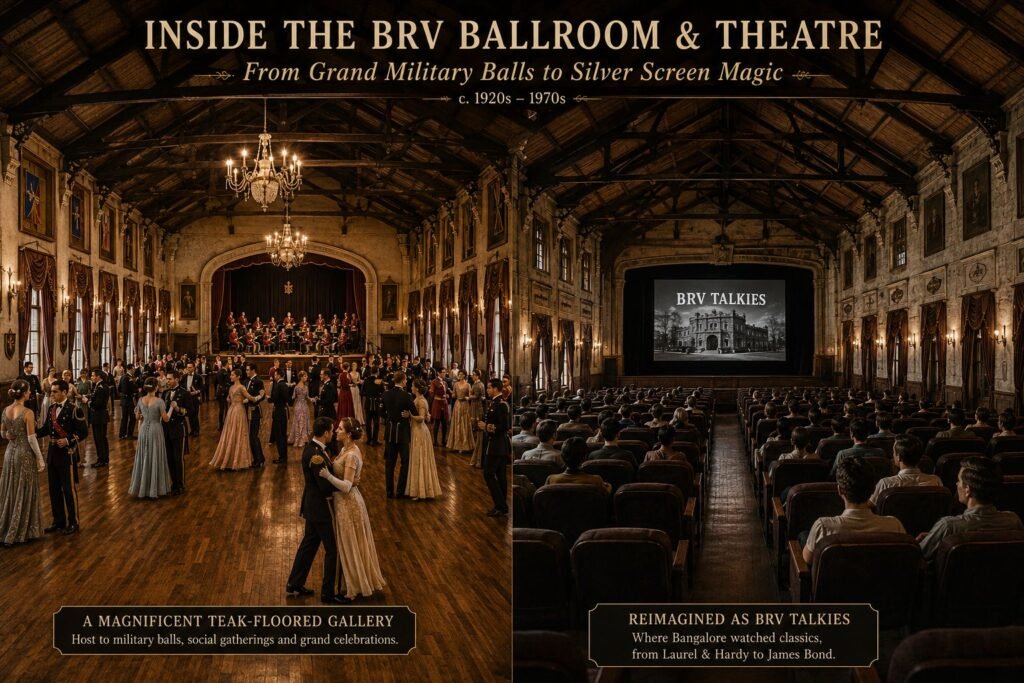
Behind the granite walls existed a world of contrasts.
The BRV Building housed regiment offices, armouries, stores, and administrative facilities.
Yet it was also a thriving social centre.
Within its walls were a billiards room, a reading room, a bar, and a magnificent 1,200-square-foot teak-floored gallery.
This grand hall hosted military balls, dances, social gatherings, and formal functions attended by officers, volunteers, and members of Bangalore’s colonial society.
By day, it was a place of military discipline.
By night, it became one of Bangalore’s most elegant social venues.
The Plot Twist: From Ballrooms to Blockbusters
When India became independent, the Bangalore Rifle Volunteers faded into history, but their building remained.
The Indian Army found an unexpected new purpose for the grand hall.
In 1959, the recreational gallery was converted into a public cinema under the Defence Services Cinema network.
The transformation was extraordinary.
The same hall that once hosted military dances now welcomed movie enthusiasts, college students, families, soldiers on leave, and film lovers from across Bangalore.
BRV Talkies quickly became one of the city’s most beloved theatres.
It screened Hollywood classics, Laurel and Hardy comedies, epic Westerns, and the early James Bond films that captivated an entire generation.
For nearly two decades, the building exchanged military ceremony for cinematic magic.
You Only Live Twice

By the late 1970s, Bangalore’s growing commercial cinema industry had begun to eclipse older theatres.
The curtain finally came down on BRV Talkies.
In a poetic twist, one of the final films associated with the theatre was the James Bond classic:
You Only Live Twice
The title proved strangely prophetic.
Because the BRV Building did not die.
It simply reinvented itself once again.
The Full Circle
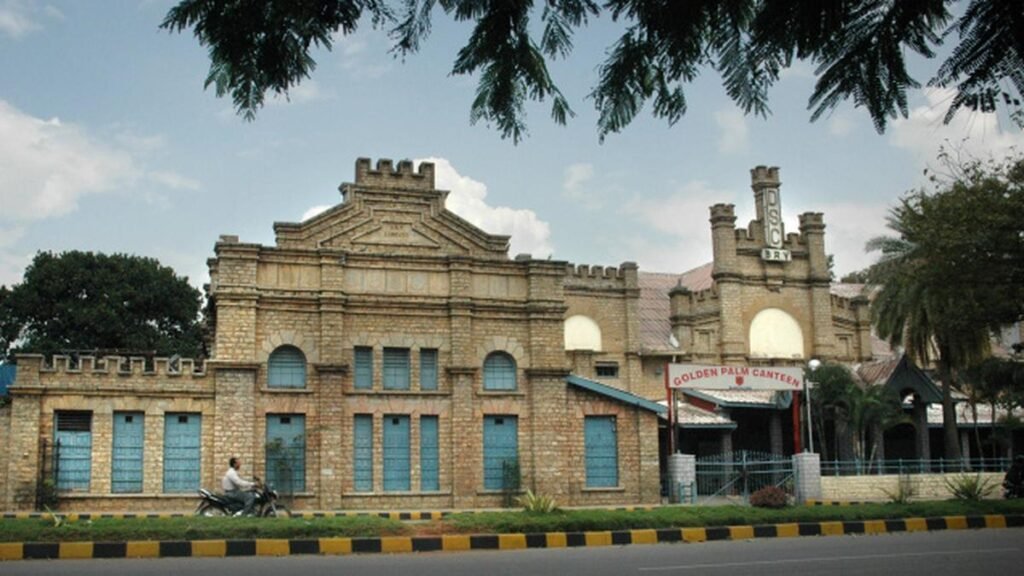
Rather than allowing the property to fall into neglect, the Indian Army reclaimed the building for its original purpose—serving the military community.
For decades, it housed the Golden Palm Army CSD Canteen, providing daily essentials to thousands of serving personnel, veterans, and their families.
The building that once supported citizen soldiers continued to support soldiers.
Only the method had changed.
An Uncertain Future
Today, however, the Golden Palm CSD Canteen has moved to a new location, leaving the old granite fortress largely silent once again.
For perhaps the first time in its long history, the question is not what the building was.
The question is what it should become.
A Heritage Worth Preserving
The BRV Building is far more than an old colonial structure.
It is one of the rare surviving landmarks that connects multiple chapters of Karnataka’s military history—from the Anglo-Mysore Wars and the Bangalore Cantonment to the Bangalore Rifle Volunteers, the Madras Sappers, and independent India’s Armed Forces.
Rather than allowing this landmark to fade into obscurity, it deserves a new life worthy of its remarkable past.
One possibility would be to transform it into a Karnataka Military Heritage Museum, celebrating the stories of the Mysore Army, the Bangalore Rifle Volunteers, the Madras Sappers, the Mysore Lancers, 61 Cavalry, and generations of soldiers who have served from this region.
Another possibility would be to restore its magnificent halls and create a heritage cultural and event venue, allowing future generations to experience one of Bangalore’s most remarkable historic buildings while ensuring its preservation.
Buildings like BRV cannot be recreated once lost.
They are custodians of memory.
When they disappear, entire chapters of history disappear with them.
Sentinels of History
The BRV Building has witnessed the aftermath of Tipu Sultan’s wars, the rise of the Bangalore Cantonment, the drills of citizen soldiers, glittering military balls, the arrival of James Bond, and generations of Indian veterans.
Few buildings in Bengaluru have lived so many lives.
Today, the old fortress waits quietly for its next chapter.
Let us hope that the chapter honours the extraordinary story written within its granite walls.
Some sentinels stand guard with rifles.
Others stand quietly at a traffic junction, preserving more than two centuries of memory.
Have a memory of BRV Talkies?
Did you watch a movie there, attend an event, or hear stories from family members about the building? Share your memories in the comments. Together, we can preserve the history of one of Bengaluru’s most remarkable military landmarks.
Further Reading & Research Sources
Readers interested in exploring the history of the BRV Building, Bangalore Cantonment, and Karnataka’s military heritage may find the following sources useful:
Books
- Bangalore: The Story of a City — Contains references to the social life, military balls, and cultural history associated with the BRV Building.
- Bangalore Through the Centuries — A valuable introduction to the city’s military and civic evolution.
- The City Beautiful — Essays on Bangalore’s cantonment heritage and colonial architecture.
- Bangalore Cantonment: A Historical Study — Useful for understanding the military origins of the cantonment.
Articles & Online Resources
- The Economic Times article, “103-year-old building now Army canteen was earlier a ballroom and later BRV Talkies“, provides an excellent overview of the building’s evolution from armoury to theatre to canteen.
- The heritage blog article “The History of an Armoury“ by Ramu Bangalore contains details about the Bangalore Rifle Volunteers, the building’s architecture, and its social functions.
- The rare 1920 postcard of the I.D.F. Hall and Warwick Majors Electric Theatre offers a fascinating glimpse into a little-known phase of the building’s history.
Have a story to Share?
If you or someone you know has lived a tough and interesting life in a military academy in India and has interesting experiences/anecdotes to share, we invite you to contribute to Fauji Tales. And if you have a story of your own — big or small — we would be honoured to preserve it.
Thank you for reading this story on Fauji Tales.
If it moved you, inspired you, or reminded you of someone who has worn the uniform with pride, please share it with others.
One more exceptional excellent article from the annals of history in Fauji tales by Capt Poorna Pragna Gudibande.
Very informative discrete information narrated very beautifully on the history of BRV BUILDING, Bangalore.
Thanks Vijay.
Best reagrds,
poorna
Awesome.
Despite the 70+ yrs of my life, sans the years in the Army, one has been a Bangalorean to the core. History in all forms have always been a fascination and history of this nature, where I grew up is simply
exhilarating.
Little known facts of this wonderful city and amongst the oldest Cantt in India.
Congratulations on enlightening the environment & reviving such indelible memories, that is long forgotten.
👏👍👃
Thank you
Thank you sir. Pls do share it among your friends. Pls share any army stories you have come across which will help this platform.
best regards,
Poorna
Thank you sir.
Best regards,
Poorna
What an amazing write-up. Kudos to writers like you who are able to weave military history and words in a way that years can be placed in one sheet. Thank you so much for sharing.
Thank you sir.
Best regards,
Poorna