Some battles are fought in the glare of headlines. Others are won in silence—and almost forgotten.
In the summer of 1999, as the nation watched Tololing and Tiger Hill unfold on television, another story was quietly taking shape far from the cameras—high on the unforgiving heights of the Siachen Glacier. Here, war was not just against the enemy, but against nature itself.
At nearly 19,000 feet stood Point 5770, a barren, icy peak on the Saltoro Range. To most, it was just another number on a map. To soldiers, it was a position that could decide the fate of entire formations.
Whoever held it could threaten the Bahadur Complex below. And at that time, it was firmly in enemy hands.
The Pakistan Army had fortified the feature and named it Bilal Post. Protected by steep approaches and covered by effective fire from positions like Pimple Post, it was considered virtually unassailable.
Several attempts had been made to capture it. All had failed.
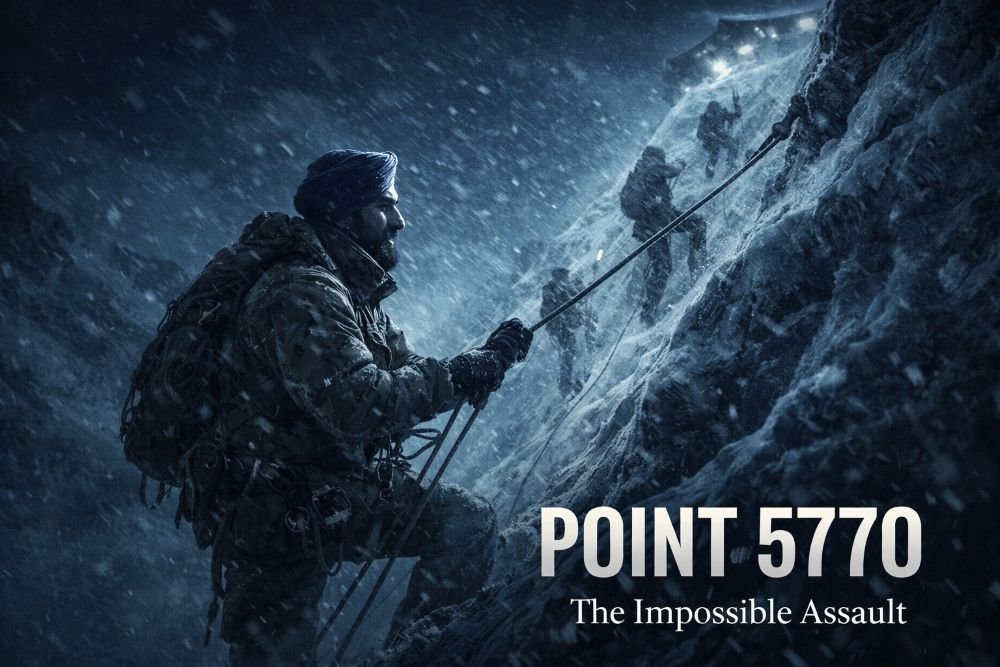
The challenge was not just the enemy—but the terrain itself. A near one-kilometre vertical ascent, sub-zero temperatures, falling ice, and oxygen levels reduced to barely one-third of sea level made even reaching the objective an ordeal.
The Plan That Broke All Rules
In conventional warfare, such an objective would demand overwhelming force—numerical superiority, artillery preparation, and sustained fire support. This operation would have none of that.
The Commanding Officer of 27 Rajput, Col (later Lt Gen) Konsam Himalay Singh, chose to rely on something far more decisive—surprise, endurance, and absolute faith in his men.
The plan was as simple as it was audacious: approach from the most difficult route—the one the enemy believed no one would attempt.
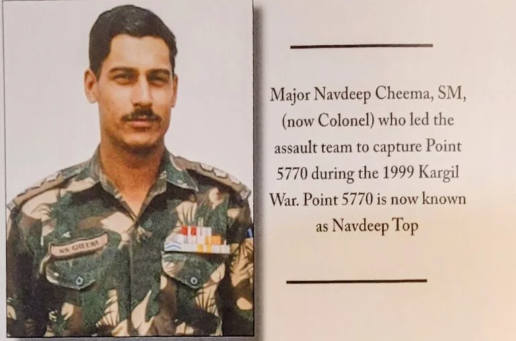
Two handpicked assault teams were chosen, each comprising eight men, led by Maj Navdeep Singh Cheema and Capt Shyamal Sinha—officers who understood that in such conditions, leadership meant leading from the front.
Before the assault could even begin, the mountain had to be negotiated. Ropes needed to be fixed along a route that was almost untraversable.
In a defining act of leadership, Col Konsam personally undertook the reconnaissance and supervised rope-fixing over two nights under blizzard-like conditions. Surprise depended on it—and failure was not an option.
The Climb Into the Unknown
On 27 June, the assault began.
The climb was relentless. Laden with weapons, ammunition, and rations, the teams inched their way upward for seven gruelling hours. At that altitude, even breathing is a challenge; every step demands effort, and fatigue builds quickly.
Yet, they kept moving.
By the time they neared the objective, exhaustion had set in—but so had clarity. They were within earshot of the enemy.
Inside Bilal Post, the defenders were unaware. Some were building sangars, others writing letters, and a few resting—confident that the terrain itself was their strongest defence.
They had not imagined that an assault could come from that direction.
The Final Assault
There was no time to pause. Even a moment’s delay could alert the sentry.
Maj Navdeep made the decision—and the assault began instantly.
The first sentry was neutralised before he could react. What followed was close-quarter combat in its most intense form—fought in cramped sangars, on icy ledges, and at point-blank range.
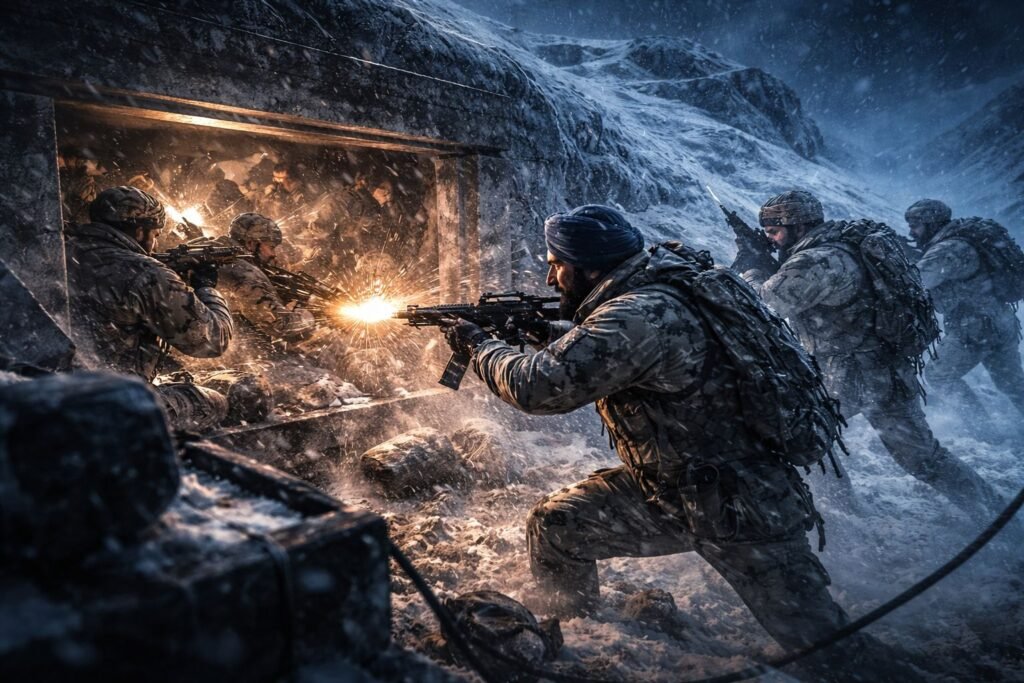
There was no room for manoeuvre, no space for error—only speed, aggression, and instinct.
Capt Shyamal’s team cleared one position while Maj Navdeep led the charge into another. The defenders, stunned by the unexpected direction of attack, struggled to respond.
Within minutes, the outcome was decided.
All eleven defenders, including their commander Captain Taimur Malik, were neutralised. So swift and decisive was the assault that the enemy could not inflict a single casualty.
As firing echoed across the glacier, the enemy brought down heavy retaliatory fire—but it was too late.
Point 5770 had been captured.
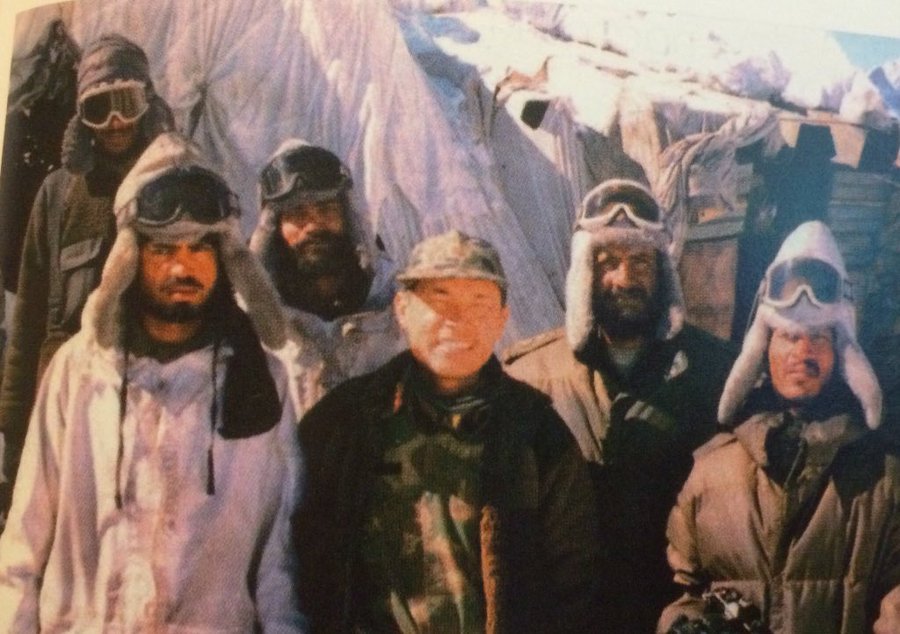
Bilal Post was renamed Navdeep Top—a tribute to the leadership and courage that had turned the impossible into reality.
In the aftermath, the Indian Army upheld its highest traditions. The fallen enemy soldiers were given full military honours, because beyond the battlefield, a soldier recognises another soldier.
Recognition… and the Questions That Remain
The capture of Point 5770 stands out as one of the most audacious operations of the Kargil War—a near-vertical assault, executed without artillery support, achieving complete surprise, and without a single casualty.
Yet, the recognition that followed has long been debated. Many military experts and historians believe that Maj Navdeep Singh Cheema’s actions were deserving of the Param Vir Chakra.
Former Chief of Army Staff Gen V.P. Malik, in his book From Surprise to Victory, described this operation as being “at par with the capture of Bana Top.”
Some refer to this as the “penalty of perfection,” where a flawlessly executed operation, without visible loss, can sometimes remain understated in recognition.
There was also the absence of visibility. Unlike Tiger Hill or Tololing, this battle was fought away from media attention—no cameras, no headlines, just soldiers executing a mission to perfection.
A Quiet Legacy
Point 5770 remains a defining example of audacious planning and resolute execution. Military historians, including studies by the US Naval War College, recognise it as one of the turning points of the Kargil War.
And yet, it remains largely unknown.
Much like Flight Lieutenant Alfred Cooke in the 1965 war—whose courage matched the highest standards but fell short of the Param Vir Chakra—this too remains a story of extraordinary bravery without the highest decoration it arguably deserved.
Some victories echo through history.
Others live quietly in the memories of the men who fought them.
Acknowledgement
This account is adapted from “Making of a General – A Himalayan Echo” by Lt Gen (Dr) Konsam Himalay Singh (Retd), PVSM, UYSM, AVSM, YSM who commanded 27 Rajput during this operation. You may buy the book from Amazon here – https://amzn.to/3QLKjzq
Note: A few images in this article are AI-generated and used for illustrative purposes. They are symbolic and do not depict real events or individuals.
Have a Story to Share?
Do you want to share any interesting incident or anecdote about life in the Indian Armed Forces?
Thank you for reading this story on Fauji Tales.
If it moved you, inspired you, or reminded you of someone who has worn the uniform with pride, please share it with others.
Enjoyed the story? Please share it among your coursemates, friends and family
Check out more such stories on Bravery in real action in Echoes of Bravery